
VPN and Secure Remote Access: Cybersecurity Best Practices for Modern Businesses
Introduction
The modern workplace has fundamentally changed. With remote work, hybrid teams, cloud applications, and globally distributed employees now standard practice, organizations must rethink how they secure access to corporate resources. Traditional perimeter based security models are no longer sufficient in a world where users connect from home networks, public
Wi-Fi, and personal devices.
This is where VPN (Virtual Private Network) and secure remote access solutions play a critical role in modern cybersecurity strategies.
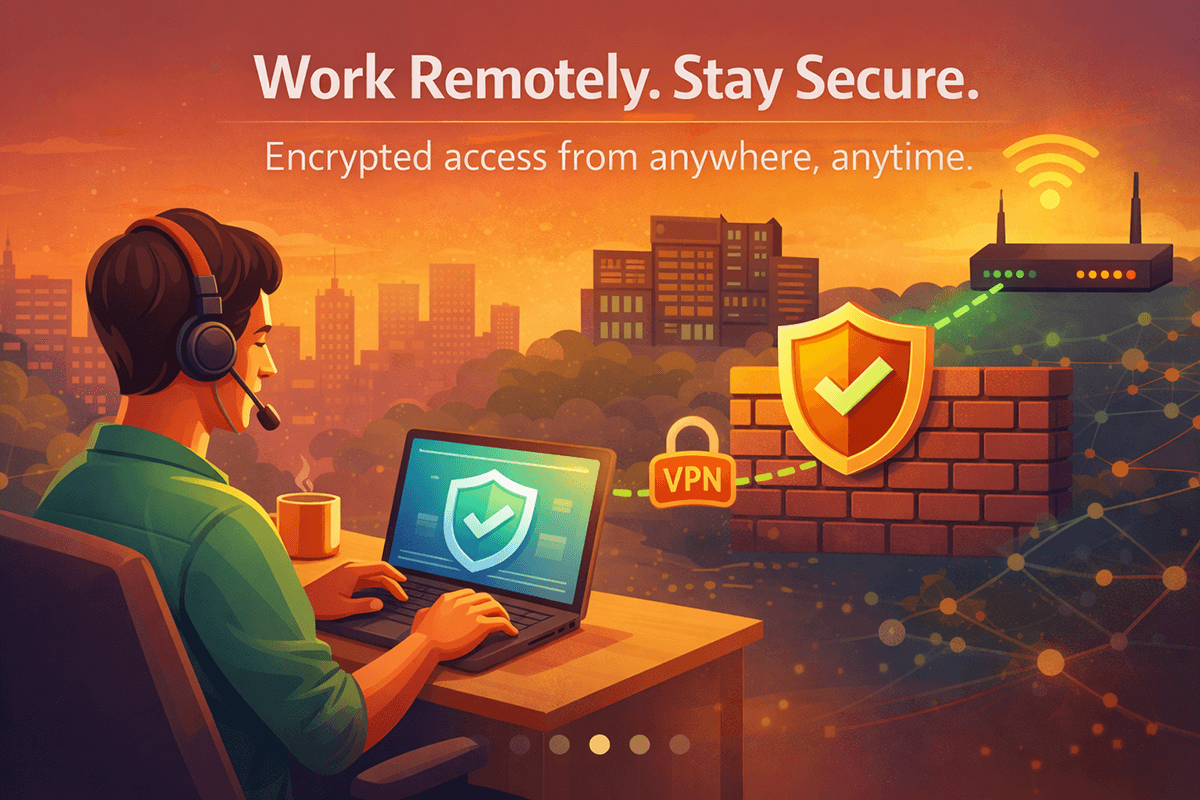
A VPN creates an encrypted tunnel between a user’s device and the organization’s network, protecting data in transit from interception. Secure remote access extends beyond traditional VPNs by incorporating identity verification, device posture checks, multi-factor authentication (MFA), zero trust principles, and granular access control.
However, simply deploying a VPN is not enough. Misconfigured or poorly managed remote access solutions have become a primary attack vector for cybercriminals. Compromised credentials and exposed VPN services are now common entry points for ransomware attacks and data breaches.
In this article, we’ll explore:
- Why VPN and secure remote access matter in cybersecurity
- Best practices to protect your business
- A real world business use case
- How to build a resilient remote access strategy
Whether you are a small business or a large enterprise, implementing secure remote access properly is essential for protecting sensitive data, maintaining compliance, and ensuring operational continuity.
Best Practices for VPN and Secure Remote Access Security
To maximize the effectiveness of your VPN and secure remote access environment, organizations should adopt a layered and proactive cybersecurity approach.
Enforce Multi-Factor Authentication (MFA)
One of the most critical best practices is implementing multi-factor authentication (MFA) for all remote access connections.
Passwords alone are not secure. Credential theft through phishing, keylogging, and data leaks is widespread. MFA adds an additional layer of protection by requiring something the user knows (password) and something they have (authentication app, hardware token) or are (biometrics).
Without MFA, even the strongest VPN encryption cannot protect against compromised credentials.
Implement the Principle of Least Privilege
Not all employees need full network access. Secure remote access solutions should enforce role-based access control (RBAC) and limit users to only the systems and data necessary for their job functions.
This reduces the attack surface and limits the damage if an account is compromised.
For example:
- Finance teams should not access development servers
- Contractors should not have unrestricted access to internal databases
- Temporary employees should have time-bound access
Granular access policies significantly improve cybersecurity resilience.
Adopt a Zero Trust Architecture
Traditional VPNs assume that once a user is connected, they are trusted. This model is outdated.
A Zero Trust security model operates under the principle: Never trust, always verify.
Secure remote access should:
- Continuously validate user identity
- Check device health and compliance
- Monitor session behavior
- Restrict lateral movement inside the network
Modern secure access solutions integrate Zero Trust Network Access (ZTNA), ensuring users only access specific applications rather than the entire network.
Keep VPN Infrastructure Updated and Patched
Unpatched VPN appliances are a frequent target for attackers. Vulnerabilities in remote access software are often publicly disclosed and quickly exploited.
Best practices include:
- Applying security patches immediately
- Disabling unused services and ports
- Regularly reviewing firmware updates
- Conducting vulnerability scans
Outdated VPN systems are a leading cause of ransomware infiltration.
Monitor and Log Remote Access Activity
Visibility is crucial in cybersecurity.
Organizations should:
- Enable detailed VPN logging
- Monitor login attempts and anomalies
- Set alerts for failed authentication spikes
- Track unusual geolocation access
Integrating VPN logs into a Security Information and Event Management (SIEM) system allows security teams to detect suspicious behavior early.
Proactive monitoring turns your VPN from a simple connectivity tool into a security intelligence asset.
Secure Endpoint Devices
A secure VPN connection does not guarantee a secure device.
If an employee’s laptop is infected with malware, that malware can use the VPN tunnel to infiltrate the corporate network.
Best practices include:
- Endpoint Detection and Response (EDR)
- Device compliance checks before granting access
- Mandatory antivirus and firewall policies
- Prohibiting jailbroken or rooted devices
Secure remote access should integrate device health verification as part of the authentication process.
Segment the Network
Network segmentation prevents attackers from moving laterally once inside.
Even if a VPN account is compromised, segmentation ensures the attacker cannot freely navigate across:
- Production systems
- HR databases
- Financial records
- Backup infrastructure
Combining VPN access with network segmentation drastically reduces breach impact.
Regularly Test and Audit Remote Access Security
Cybersecurity is not a one-time deployment.
Organizations should:
- Conduct penetration testing
- Perform configuration reviews
- Simulate phishing campaigns
- Audit user access permissions
Routine security assessments ensure VPN and secure remote access systems remain aligned with evolving threats.
Real-World Use Case: Secure Remote Access for a Financial Services Firm
Consider a mid-sized financial services company with 250 employees operating across multiple regions.
The Challenge
The organization transitioned to a hybrid work model. Employees required access to:
- Internal financial applications
- Client records
- Email servers
- Cloud-based accounting systems
Initially, the company deployed a basic VPN solution with username and password authentication. Within months, they encountered multiple cybersecurity risks:
- Phishing attempts targeting employee credentials
- Brute-force login attempts on the VPN gateway
- Unmonitored contractor access
- Outdated VPN firmware vulnerabilities
The risk of a data breach involving sensitive financial data was significant.
The Solution
The company upgraded its remote access strategy by implementing:
- Multi-Factor Authentication (MFA)
- Zero Trust Network Access (ZTNA)
- Endpoint compliance checks
- Network segmentation
- Real-time monitoring with SIEM integration
Contractors were given time-limited access to specific applications rather than full network connectivity.
The Outcome
After implementing these improvements:
- Unauthorized login attempts dropped significantly
- Credential compromise no longer led to full access
- Regulatory compliance improved
- Security audits showed reduced attack surface
- Incident response visibility increased
This example demonstrates that VPN alone is not enough. A layered secure remote access approach protects both data and business continuity.
Conclusion
VPN and secure remote access solutions are foundational components of modern cybersecurity. As businesses continue to embrace remote and hybrid work models, protecting access to corporate resources becomes increasingly critical.
To build a secure remote access environment, organizations must:
- Enforce multi-factor authentication
- Adopt Zero Trust principles
- Limit access through least privilege
- Monitor and log remote activity
- Secure endpoint devices
- Segment networks
- Keep systems updated and patched
A well-designed VPN and secure remote access strategy does more than enable remote work it strengthens the entire cybersecurity posture of the organization.
In today’s threat landscape, remote access security is not optional. It is a business imperative.
Secure Your Remote Workforce Today
Remote access security is no longer optional it’s critical to protecting your business, your data, and your reputation.
If your organization relies on VPN or remote connectivity, now is the time to assess whether your current setup truly meets modern cybersecurity standards.
Contact us today to schedule a consultation and discover how we can design and implement a secure, scalable VPN and secure remote access solution tailored to your business needs.
👉 Get in touch with our cybersecurity team to strengthen your remote access security.